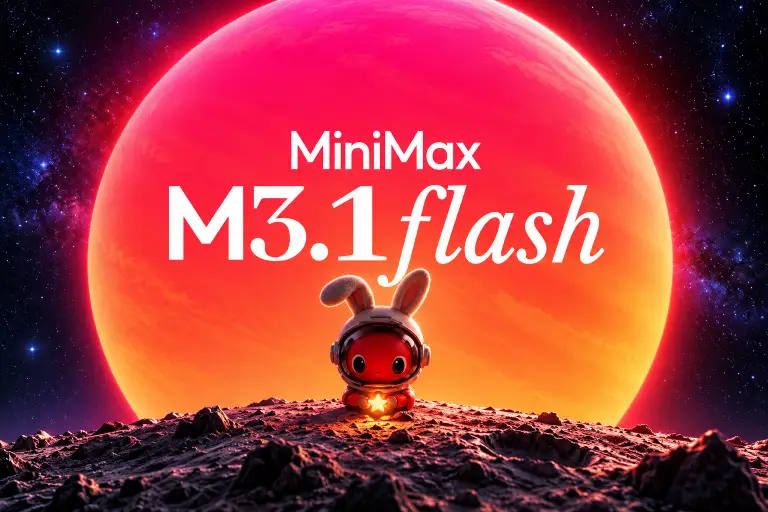
Chinese artificial intelligence startup MiniMax has launched M3.1 Flash, an upgraded AI model designed to improve coding, autonomous AI agents, computer-use tasks and cybersecurity. The company says the new model delivers nearly three times faster online inference and reduces overall usage costs for agentic tasks by 70% compared with its predecessor.
Announced on October 19, 2026, M3.1 Flash targets developers and businesses seeking faster AI-powered automation without the higher costs associated with more computationally intensive models.
What makes MiniMax M3.1 Flash different?
MiniMax says M3.1 Flash improves performance across several areas, including software development, multi-step reasoning, computer interaction and cybersecurity.
The model is designed to handle agentic workflows, in which AI systems perform sequences of tasks rather than simply responding to individual prompts. These workflows can include working across business applications, analysing information, writing code and completing operational tasks.
According to MiniMax, the model can generate more than 200 tokens per second in everyday usage scenarios, with median output speeds exceeding 170 tokens per second. Actual performance can vary depending on the task, configuration and operating conditions.
MiniMax claims 70% lower usage costs
Cost efficiency is a central part of the new model’s positioning. MiniMax says M3.1 Flash reduces overall usage costs for agentic tasks by 70% compared with the previous generation.
The company lists API pricing at $0.15 per million input tokens and $0.60 per million output tokens, with cached input priced at $0.015 per million tokens.
Lower inference costs could make it more economical for developers to run AI agents that repeatedly process information, write code or interact with software applications. However, actual savings depend on token consumption, task complexity and how efficiently each model completes a workflow.
Coding and cybersecurity capabilities
MiniMax is also positioning M3.1 Flash for software engineering and cybersecurity applications. The company reports improvements in code development, vulnerability discovery, code auditing and security analysis.
These capabilities could help developers automate parts of software development and assist security teams with technical investigations. However, AI-generated code and security assessments still require human review, particularly when systems handle sensitive information or production infrastructure.
MiniMax cites internal evaluations and external benchmarks to support its performance claims. Independent testing across comparable workloads will be important to establish how the model performs against competing AI systems.
Where can developers access M3.1 Flash?
MiniMax says M3.1 Flash is available through its API, M Plan subscription service and MiniMax Code. The company has also said that model weights will be released later, meaning developers should check its official channels for the latest availability details.
The launch reflects the growing competition among AI developers to deliver models that combine strong reasoning and coding capabilities with faster responses and lower operating costs.
For businesses building AI agents, the ability to complete complex tasks efficiently could be as important as performance on conventional benchmarks. Whether M3.1 Flash delivers consistent advantages in real-world deployments will depend on independent evaluations and practical developer experience.