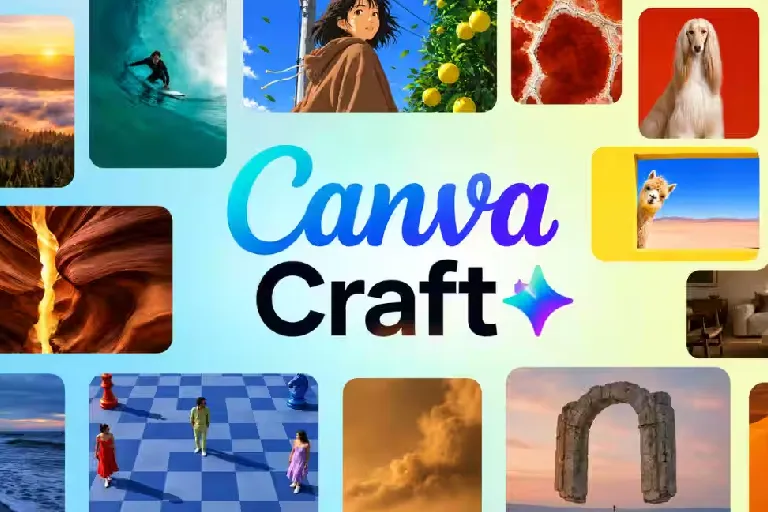
Canva has launched Canva Craft, a new AI image generator designed to improve text, layouts and editable elements. The company announced the model on October 22, 2026. It is available globally through Canva’s Dream Lab and supports image generation at resolutions of up to 2K.
Unlike conventional image generators, Craft uses a two-stage process. First, it plans the composition, including object placement and typography. Then, a second model renders the image. Canva says this approach improves precision and makes complex designs easier to create.
The launch strengthens Canva’s efforts to develop its own AI technology. It also puts the company in closer competition with established AI image-generation platforms.
Canva Craft improves text and design accuracy
Canva designed Craft for practical design tasks. These include social media graphics, posters, presentations, advertisements and infographics.
The model first interprets a prompt and plans the layout. It then generates an image based on that plan. This approach aims to reduce common problems such as misplaced objects, inconsistent layouts and poorly rendered text.
Craft supports more than 30 aspect ratios. This allows users to create visuals for different platforms and formats. The model also supports prompts in multiple languages. According to Canva, it can generate text in 55 languages.
AI-generated images become easier to edit
One of Craft’s key features is its compatibility with Canva’s Magic Layers technology. This technology can separate an image into individual design elements.
Users can then modify parts of a design instead of treating the entire image as a single, flat file. For example, a creator could generate a promotional graphic and adjust its text or reposition elements.
This could save time for marketing teams and content creators. They often need multiple versions of the same visual for different platforms.
However, results may vary depending on the image. Users might still need to make manual corrections before publishing their designs.
Canva expands its AI image-generation ambitions
Canva’s launch puts it in more direct competition with AI image-generation platforms from OpenAI, Google and other companies. Its strategy combines image creation with the editing tools already available on its platform.
The company says Craft was trained using millions of human-created templates from its content library. These templates cover posters, presentations, social media posts, menus and other design formats.
Canva also reports that its internal evaluations involved more than 25,000 image pairs. The company compared results with leading models across several design categories.
These findings are based on Canva’s own evaluations. Independent testing will help establish how the model compares with competing tools in everyday use.
Craft brings AI image generation to developers
Canva is also making Craft available to developers through its public API. This allows businesses to explore integrating AI image generation into their products and workflows.
The company has outlined plans for faster versions called Craft-fast and Craft-ultrafast. It has also indicated that additional editing and reference-image capabilities are in development.
These improvements could make the tool more useful for businesses that produce visuals at scale.
What Canva Craft means for creators
Canva Craft could make AI-generated visuals more practical for creators, small businesses and marketing professionals. Its focus extends beyond attractive images to usable designs that people can refine.
The combination of improved typography, structured layouts and editable elements addresses several challenges in AI-assisted design.
For creators who already use Canva, Craft offers another way to produce and refine visuals within a familiar platform. Its real-world value will depend on the quality of its output and how well its editing features work across different design tasks.
Also Read: Google’s Gemini 4 Argon AI Model