
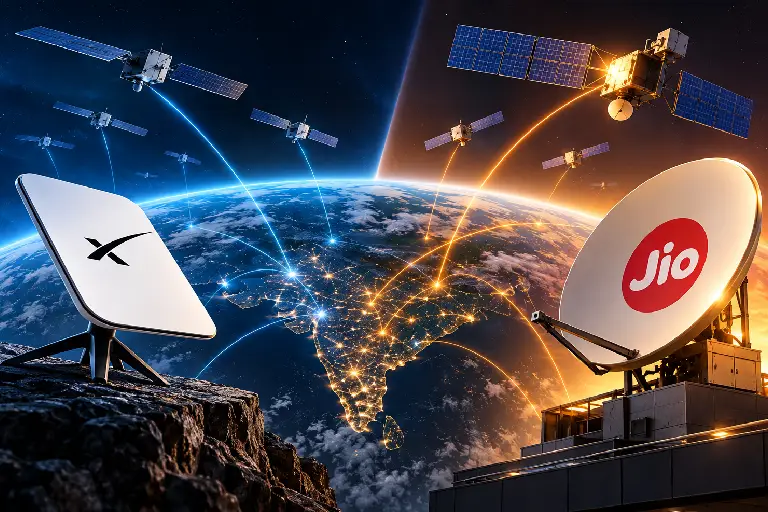
Reliance Jio is exploring its own satellite broadband network as competition in India’s satellite connectivity market intensifies. However, the telecom operator believes satellite internet could struggle to compete with existing broadband services on price, even as it recognises the technology’s potential to disrupt the connectivity industry.
According to Jio Platforms Limited’s red herring prospectus (RHP), filed with the Securities and Exchange Board of India (SEBI) on October 15, the company is evaluating an indigenous satellite constellation and ground infrastructure, alongside potential partnerships with leading global satellite operators.
Jio explores a 1,600-satellite network
Jio Platforms is planning a low-Earth orbit (LEO) satellite constellation comprising approximately 1,600 satellites. The proposed network would be separate from Jio Satellite Communications, its existing joint venture with satellite operator SES, which focuses on medium-Earth orbit satellite services.
Jio said its proposed satellite connectivity solutions would particularly target remote and underserved locations where building conventional telecommunications infrastructure can be difficult or expensive.
The company is also evaluating partnerships with international satellite constellation providers to accelerate service availability. However, it has cautioned that there is no guarantee its planned network will be deployed on schedule, achieve regulatory approvals or become commercially competitive.
Why Jio questions satellite broadband pricing
Despite pursuing satellite connectivity, Jio believes the technology may struggle to compete with India’s existing broadband options on price.
The company pointed to the expansion of fixed wireless access (FWA), which uses wireless networks to deliver home and business internet without requiring a traditional fibre connection to every premises. Jio argued that these services, particularly unlicensed-band radio (UBR)-based FWA, could offer a lower-cost alternative to satellite broadband.
Jio cited Starlink’s entry-level fixed broadband pricing in the United States at approximately ₹4,800 per month, alongside prices of around ₹2,500 to ₹4,500 in several African markets. These figures were cited by Jio in its prospectus and are not confirmed prices for a future Starlink service in India.
Nevertheless, satellite broadband could remain valuable in remote regions, government facilities and enterprise locations where terrestrial networks are difficult to deploy.
Starlink and OneWeb add competitive pressure
Jio’s plans come as Starlink, operated by SpaceX, and Bharti Group-backed Eutelsat OneWeb pursue satellite broadband opportunities in India.
All three operators were awaiting the necessary security clearances to begin commercial services, according to the October 15 report. Their progress will depend on regulatory approvals and the applicable spectrum framework.
Satellite connectivity could eventually compete with JioFiber, JioAirFiber and other fixed broadband offerings, particularly for customers in rural and underserved areas. Jio also identified satellite services as a potential business risk if rival networks expand faster than expected or become more cost-effective.
Spectrum allocation remains a key concern
Jio has raised concerns about India’s administrative allocation of satellite spectrum, contrasting it with the auction-based approach used for terrestrial telecom spectrum.
The company warned that the framework could lower entry barriers for satellite operators and create new competitive pressures for established connectivity providers.
Jio also noted that satellite spectrum is a shared resource managed internationally, rather than an asset exclusively owned by a single operator. The evolving regulatory framework could therefore influence the economics of satellite broadband services in India.
What happens next?
Jio’s satellite ambitions highlight the growing importance of space-based connectivity in India’s telecom market. However, its own assessment suggests that affordability, deployment costs and regulatory approvals will determine how quickly satellite internet can expand.
For now, the company is evaluating its network and partnership options rather than announcing a confirmed commercial launch date. The competition between satellite operators and terrestrial broadband providers is likely to depend on which technologies can deliver reliable connectivity at a price customers are willing to pay.
Read more : India stands firm on Starlink security rules