
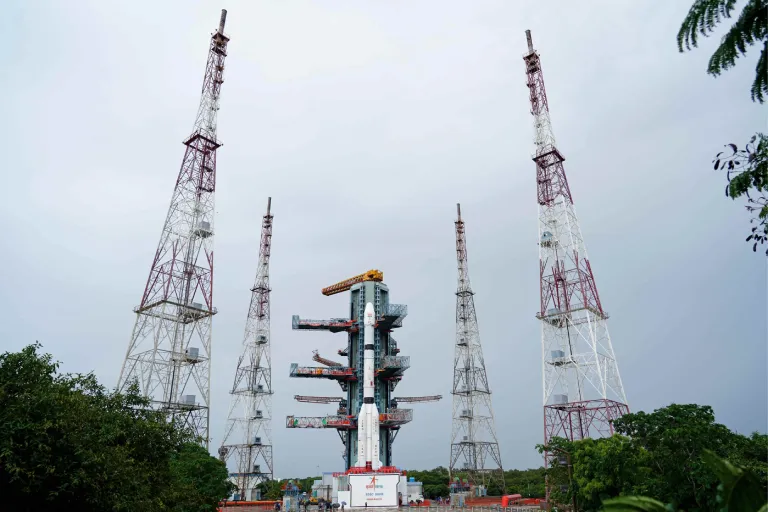
The Indian Space Research Organisation (ISRO) has successfully launched its NVS-03 navigation satellite. The GSLV-F18 rocket carried the satellite into space on October 30, 2026. The launch took place at Sriharikota, Andhra Pradesh.
The mission marks another step towards strengthening India’s independent navigation system, NavIC. ISRO will now move the satellite towards its designated orbital position.
ISRO successfully launches NVS-03 satellite
The GSLV-F18 rocket lifted off from the Satish Dhawan Space Centre at 11:51 PM IST. It carried the 2,232-kg NVS-03 satellite into Geosynchronous Transfer Orbit (GTO).
The rocket completed its mission successfully. ISRO then began preparing the spacecraft for its next orbital manoeuvres.
NVS-03 completes its first orbit manoeuvre
ISRO completed the first orbit-raising manoeuvre on October 31 at 4:48 PM IST. The satellite’s Liquid Apogee Motor operated for approximately 2,174.8 seconds.
The manoeuvre placed the spacecraft in an orbit of approximately 5,477.6 km by 37,833.4 km. ISRO also confirmed that the satellite remains in normal health.
The space agency plans further manoeuvres in the coming days. These operations will move NVS-03 into its designated geostationary orbital slot at 111.75 degrees East.
How NVS-03 improves India’s NavIC system
NVS-03 belongs to ISRO’s second-generation navigation satellite series. It is the third satellite in this series. The mission aims to improve the availability and reliability of NavIC services.
The satellite carries an indigenous atomic clock. It also includes procured atomic clocks for navigation and timing operations.
Another major upgrade involves the L1 navigation frequency. NVS-03 adds L1 support alongside the existing L5 and S-band signals.
This addition will improve compatibility with civilian navigation receivers. It will also expand the potential applications of India’s navigation system.
Why India’s NavIC system matters
NavIC stands for Navigation with Indian Constellation. It provides positioning, navigation and timing services across India. Its coverage also extends approximately 1,500 kilometres beyond the country’s borders.
The system supports several important applications. These include road transportation, maritime navigation and emergency services. It also supports strategic and infrastructure operations.
India developed NavIC to reduce its dependence on foreign navigation systems. The constellation plays an important role in the country’s space and technology infrastructure.
Previous satellite failures affected NavIC
NavIC has faced operational challenges due to satellite failures. The NVS-02 satellite encountered problems during its orbit-raising operations in January 2025.
The failure affected the constellation’s ability to maintain its full operational capacity. NVS-03 now represents another important addition to the navigation network.
However, the satellite must complete its remaining manoeuvres and commissioning. Only then can it begin providing operational navigation services.
What comes next for ISRO’s NVS-03 mission
ISRO will continue moving the satellite towards its designated orbital position. The successful first manoeuvre marks encouraging progress.
Once commissioned, NVS-03 will strengthen India’s independent navigation infrastructure. It will also support the country’s efforts to expand indigenous satellite technology.
The mission highlights ISRO’s progress in satellite navigation and atomic clock development. It marks another milestone in India’s efforts to build a reliable domestic navigation network.