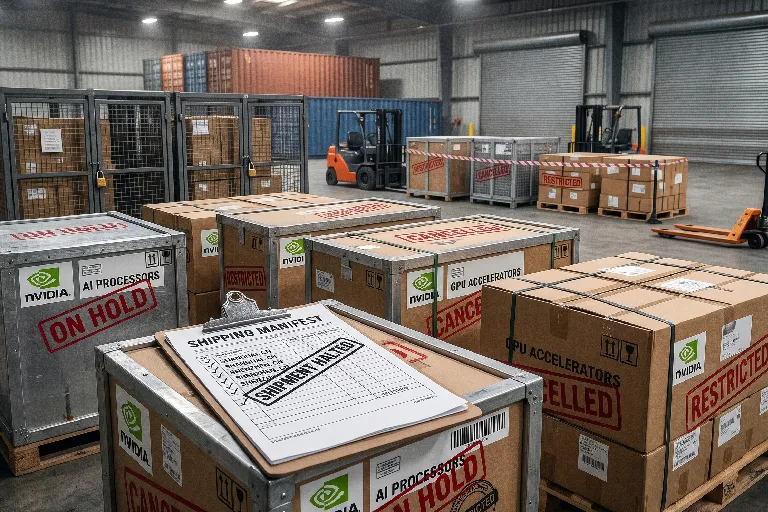
Nvidia has stopped shipping licensed AI chips to China, raising fresh questions about the future of US-China semiconductor trade. The announcement comes after the American chipmaker generated $2.4 billion from licensed Hopper-generation data-centre products in China during its latest reported quarter.
According to Reuters, Nvidia interim CEO Colette Kress confirmed the decision during an earnings call on November 17. She said the company’s latest financial outlook does not include further licensed Hopper chip shipments to China.
The announcement marks a significant development in the global AI semiconductor industry. However, Nvidia has not confirmed whether the shipping halt will become permanent.
Nvidia Halts Licensed Hopper Chip Shipments
Nvidia’s Hopper processor family includes the powerful H200 AI chip. These processors help data centres train and operate advanced artificial intelligence models.
During the quarter ended October 25, Nvidia generated $2.4 billion from licensed Hopper-generation products shipped to China.
However, the company has now stopped these shipments. Kress did not provide a specific reason for the decision.
Furthermore, Nvidia has not included additional licensed Hopper products in its current financial outlook.
US Export Rules Complicate Nvidia’s China Business
The United States introduced strict semiconductor export controls in 2022. These restrictions limited China’s access to advanced American AI processors.
However, Washington changed its licensing approach in January 2026. The new policy allows authorities to review certain H200 chip export applications individually.
The approval process includes several security conditions. These include independent testing in the United States and requirements to protect domestic chip supplies.
The arrangement also introduced a 25% tariff on eligible chips entering the United States before shipment to China.
Washington approved H200 sales to several Chinese technology companies. These reportedly included Alibaba, Tencent and ByteDance.
China Also Restricts Nvidia AI Chip Imports
US export restrictions are not the only challenge facing Nvidia.
Beijing has also limited imports of certain advanced American processors. China wants to strengthen its domestic semiconductor industry and reduce reliance on foreign technology.
According to Reuters, approximately 600,000 Nvidia H200 chips were being held in Hong Kong while awaiting approval for large-scale shipments into mainland China.
Meanwhile, several major Chinese internet companies had reportedly acquired around 10,000 H200 processors each.
These developments highlight the complicated position of American chipmakers in China’s rapidly growing AI market.
Nvidia Faces Uncertainty in the Chinese AI Market
China remains an important market for the global semiconductor industry. However, regulatory restrictions from both Washington and Beijing continue to create uncertainty.
For Nvidia, the latest shipping halt raises questions about future revenue opportunities in the country.
At the same time, Chinese technology companies are investing in domestic AI processors and computing infrastructure.
The situation could further influence competition between American and Chinese semiconductor manufacturers.
Although Nvidia has not announced a permanent withdrawal from China, its decision to stop licensed Hopper shipments marks another major development in the ongoing technology rivalry between the two countries.